

E85:Green Revolution or Hidden Risk?
As countries around the world search for cleaner and more sustainable energy solutions, biofuels are becoming increasingly important. One such fuel gaining attention in India is E85 fuel. With the Indian government recently launching E85 at selected fuel stations, many vehicle owners are curious about what it is and whether they can use it in their vehicles. India’s move toward cleaner and more sustainable fuels has brought E85 into the spotlight

What is E85?
E85 is a fuel blend that contains approximately 85% ethanol and 15% petrol (gasoline). Ethanol is a renewable biofuel produced from crops such as sugarcane, maize, and other agricultural products.
Unlike conventional petrol, E85 contains a much higher percentage of ethanol, making it a cleaner and more environmentally friendly fuel option. It is commonly used in countries such as Brazil and the United States and is now being introduced in India as part of the country’s biofuel strategy.
Quick Facts
E85 contains 80–85% ethanol.
The remaining 15–20% is conventional petrol.
It produces lower carbon emissions than regular petrol.
It supports domestic agriculture and ethanol production.
It is designed primarily for Flex-Fuel Vehicles (FFVs)
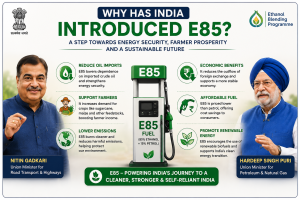
Why Has India Introduced E85?
India imports a significant portion of its crude oil requirements. This creates both economic and energy security challenges. To reduce dependence on imported oil, the government has been promoting ethanol blending programs.
The introduction of E85 aims to:
Reduce crude oil imports.
Support Indian farmers.
Lower greenhouse gas emissions.
Promote renewable energy.
How Does this Fuel Work?
Ethanol burns differently from conventional petrol. It has a higher octane rating, which can improve engine performance in vehicles specifically designed to use it.
When used in compatible vehicles, E85 can:
Deliver smoother combustion.
Reduce harmful exhaust emissions.
Improve engine efficiency under certain conditions.
Lower the carbon footprint of transportation.
However, because ethanol contains less energy per liter than petrol, fuel economy may sometimes be slightly lower.
Benefits of E85 Fuel
1. Environmentally Friendly
One of the biggest advantages of this fuel is to reduces the environmental impact. Ethanol is a renewable resource and generally produces fewer harmful emissions.
2. Reduced Oil Imports
Using domestically produced ethanol helps reduce India’s dependence on foreign oil markets.
3. Support for Farmers
Ethanol production creates additional demand for crops such as sugarcane and maize, benefiting farmers and rural economies.
4. Potential Cost Savings
The government has announced plans to keep E85 cheaper than regular petrol, making it attractive for consumers.
5. High Octane Fuel
It typically offers a higher octane rating, which can benefit engines designed to take advantage of it.
Can All Cars and Bikes can Use this fuel?
The simple answer is No.
Why Can’t Regular Vehicles Use E85?
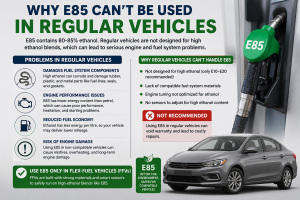
Most conventional petrol vehicles are designed for low-ethanol fuel blends such as E10 or E20. High ethanol concentrations can affect:
Fuel lines
Rubber seals
Fuel pumps
Engine calibration
Fuel injectors
Using this fuel is aa non-compatible vehicle may lead to engine problems, reduced performance, and increased maintenance costs.
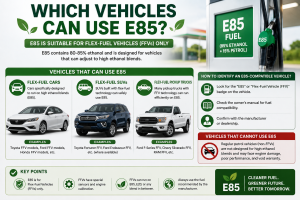
Which Vehicles Can Use E85?
It is specifically intended for:
Flex-Fuel Vehicles (FFVs)
Vehicles engineered for high ethanol blends
Certain specially modified engines
Flex-Fuel Vehicles have sensors and engine systems that automatically adjust to varying ethanol concentrations.
Before filling this fuel, vehicle owners should always check their manufacturer’s recommendations.
Can All Cars and Bikes Use Can Use This Fuel Important Considerations
Check your owner’s manual.
Confirm if your vehicle is a Flex-Fuel Vehicle.
Consult your dealership or manufacturer.
Avoid experimenting with this fuel in standard petrol vehicles.
E85 vs Regular Petrol
| Feature | E85 | Regular Petrol |
|---|---|---|
| Ethanol Content | 80-85% | Very Low |
| Renewable | Yes | No |
| Carbon Emissions | Lower | Higher |
| Crude Oil Dependency | Lower | Higher |
| Vehicle Compatibility | FFVs Only | Most Vehicles |
| Environmental Impact | Better | Higher Impact |
Challenges of E85 Adoption
Despite its benefits, E85 faces several challenges:
Limited Vehicle Compatibility
Most existing vehicles cannot use this fuel without modifications.
Fuel Infrastructure
very fuel infrastructure are providing but still limited in number.
Consumer Awareness
Many consumers are unaware of the differences between E20 and E85 fuels.
Fuel Economy Concerns
Ethanol has lower energy density than petrol, which can slightly affect mileage.
Future of E85 in India
India’s biofuel mission is expected to expand significantly over the coming years. As more Flex-Fuel Vehicles enter the market and fuel infrastructure develops, it could become a major component of India’s transportation sector.
FAQ
What is E85 fuel made of?
this fuel consists of approximately 85% ethanol and 15% petrol.
2. Can all cars and bikes use this fuel
No. Only Flex-Fuel Vehicles and specially designed engines can safely use E85.
3. Is E85 cheaper than petrol?
In many cases, governments promote this fuel with lower pricing to encourage adoption.
4. Does E85 reduce pollution?
Yes. it generally produces lower greenhouse gas emissions compared to conventional petrol.
5. Why is India promoting this fuel
India is promoting this fuel because to reduce oil imports, support farmers, and improve environmental sustainability.
Conclusion
Understanding what is E85 is becoming increasingly important as India moves toward cleaner and more sustainable fuel options. this fuel offers several benefits, including reduced emissions, support for farmers, and lower dependence on imported oil. However, one crucial fact remains: not all vehicles are compatible with this fuel.
Before using this fuel , always verify whether your vehicle is approved for high-ethanol blends. As Flex-Fuel Vehicle adoption grows, this fuel may play a significant role in India’s energy future. click here to read out interesting article
Pingback: Made-in-India Airbus C295 -
Pingback: CBSE's Big Revaluation Shake-Up: Answer Sheets Go Physical -