
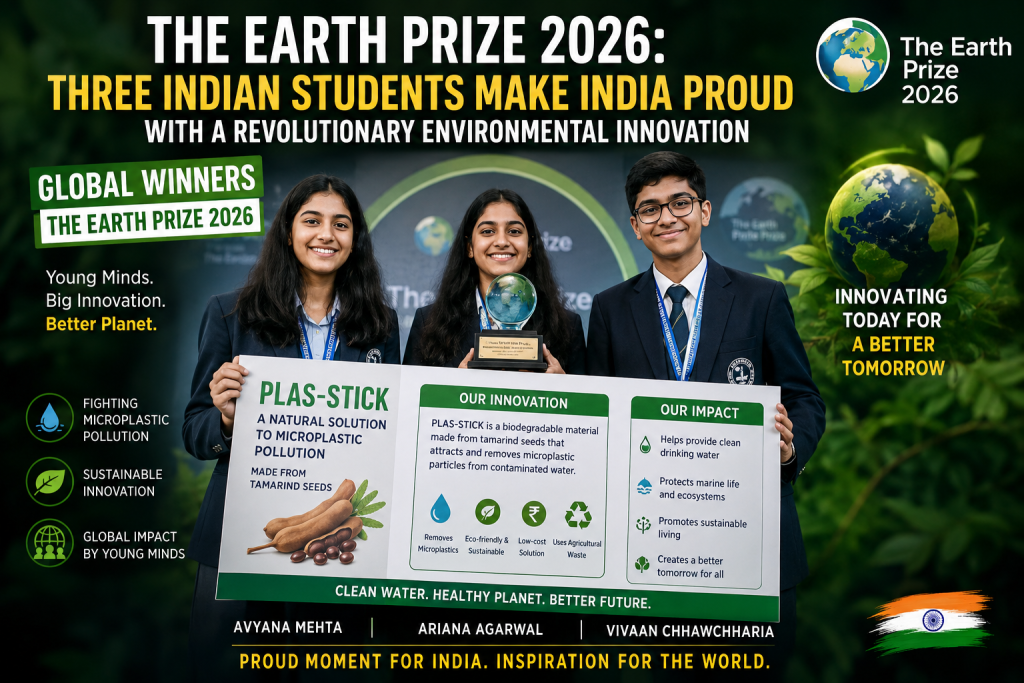
The Earth Prize 2026: Three Indian Students Make India Proud with a Revolutionary Environmental Innovation
India has a proud moment at the Earth Prize 2026, with three young students winning the coveted global title for developing an innovative solution to one of the world’s fastest-growing environmental problems – microplastic pollution. Their success proves that determination, scientific curiosity and creative thinking can yield ideas that have the potential to improve millions of lives.”
Avyana Mehta, Ariana Agarwal and Vivaan Chhawchharia are the winners, and they have developed Plas-Stick, an eco-friendly material made from discarded tamarind seeds. Their innovation efficiently captures and eliminates harmful microplastic particles from polluted water. The project fetched them the Global Winners of The Earth Prize 2026 title and made them the first Indian team to get the highest honour of the competition.
What Is the Earth Prize 2026?
The Earth Prize 2026 is a leading global environmental innovation competition for young people aged 13-19. Students are challenged in the competition to find actual environmental problems and to devise practical, scalable, and sustainable solutions.
Every year, the Earth Prize 2026 brings together thousands of student innovators from countries around the world. Participants present projects on climate change, pollution, biodiversity conservation, clean water, renewable energy, waste management, sustainable agriculture and other global environmental issues.
The contest celebrates creativity, scientific research, teamwork and the ability to make a positive impact on the environment
Meet the Three Indian Global Winners
The Indian side will be:
- Avyana Mehta
- Ariana Agarwal
- Vivaan Chhawchharia
Instead of seeing plastic pollution as a problem without a solution, these students looked for a sustainable, cheap solution. After a lot of research and experimentation, they found discarded tamarind seeds have natural properties that can help to capture microplastic particles if processed in the right way.
Their teamwork, scientific approach, and commitment to sustainability impressed the international judging panel and secured the top global award.
What Is Plas-Stick?
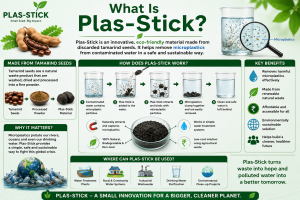
Plas-Stick is a new biodegradable material made of waste tamarind seeds. Students treated the seed powder to increase its attractiveness to microscopic plastic particles floating in water.
When combined with water treatment, Plas-Stick clings to microplastics, making them easier to pull apart and remove. The technology provides a low-cost alternative to many existing filtration methods because tamarind seeds are cheap and readily available.
Unlike synthetic chemical treatments, Plas-Stick relies on agricultural waste, making it both environmentally friendly and sustainable.
Why Microplastic Pollution Is a Global Crisis
‘Microplastic’ is a term used to describe tiny plastic particles that are less than five millimetres. They come from broken plastic products, synthetic clothing fibres, industrial waste, cosmetics and packaging materials.
Scientists have detected microplastics in oceans, rivers, lakes, drinking water, seafood, agricultural soil, and even human blood. Their widespread presence has raised serious concerns about long-term environmental and health impacts.
Microplastic pollution causes several major problems:
- It contaminates drinking water.
- Marine animals mistake plastic for food.
- Plastic particles enter the human food chain.
- Ecosystems lose biodiversity.
- Wildlife suffers injury and starvation.
- Plastic waste persists in nature for hundreds of years.
The innovation presented at The Earth Prize 2026 directly addresses this urgent environmental challenge by offering a practical method to remove microplastics before they spread further.
Why Plas-Stick Is an Important Innovation
Many existing technologies for removing microplastics require expensive equipment or complex filtration systems. These solutions often remain inaccessible for developing regions.
Plas-Stick offers several important advantages:
- Uses agricultural waste instead of synthetic materials.
- Provides an affordable purification solution.
- Supports sustainable waste management.
- Reduces dependence on costly filtration technologies.
- Can potentially benefit both urban and rural communities.
- Encourages circular economy practices by converting waste into useful products.
This combination of affordability, sustainability, and effectiveness made Plas-Stick stand out during the Earth Prize 2026.
Why This Achievement Matters for India
Winning The Earth Prize 2026 highlights India’s growing role in scientific innovation and environmental leadership. The success of these students demonstrates that world-changing ideas can emerge from young innovators with curiosity and determination.
Their achievement inspires schools, colleges, research institutions, and policymakers to encourage student-led innovation.
It also sends a powerful message that solving environmental challenges requires collaboration, creativity, and scientific thinking rather than waiting for governments or large corporations alone.
Lessons Every Student Can Learn
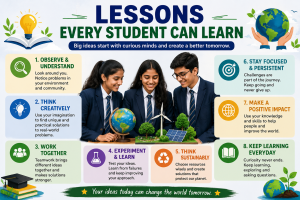
The success of these three students offers valuable lessons for young innovators:
- Observe problems in everyday life.
- Use scientific research to develop practical solutions.
- Work as a team.
- Think sustainably.
- Transform waste into useful resources.
- Never stop experimenting.
- Believe that young people can create global impact
Frequently Asked Questions (FAQs)
Who won The Earth Prize 2026?
Avyana Mehta, Ariana Agarwal, and Vivaan Chhawchharia from India became the global winners of The Earth Prize 2026.
What is Plas-Stick?
Plas-Stick is a biodegradable material developed from discarded tamarind seeds that helps remove microplastic particles from contaminated water.
Why is microplastic pollution dangerous?
Microplastics contaminate water, harm marine ecosystems, enter the food chain, and may affect human health over time.
Why did the students receive the Earth Prize 2026?
They created an affordable, sustainable, and innovative technology for removing microplastics from water using agricultural waste.
Why is the Earth Prize important?
The Earth Prize encourages teenagers worldwide to create practical environmental solutions that can positively impact communities and the planet
Conclusion
The Earth Prize 2026 showcases the extraordinary potential of young innovators to solve some of the world’s most pressing environmental challenges. By transforming discarded tamarind seeds into an effective tool for removing microplastics, Avyana Mehta, Ariana Agarwal, and Vivaan Chhawchharia have demonstrated how creativity, science, and sustainability can work together to protect the planet. Their achievement not only brings pride to India but also inspires students worldwide to believe that innovative ideas can create meaningful environmental change. As the global fight against pollution continues, their success stands as a powerful reminder that the next breakthrough may come from the imagination and determination of young minds.
Pingback: Supreme Court to CBSE: “Burn the Midnight Oil” Over Class 12 Improvement Results -