
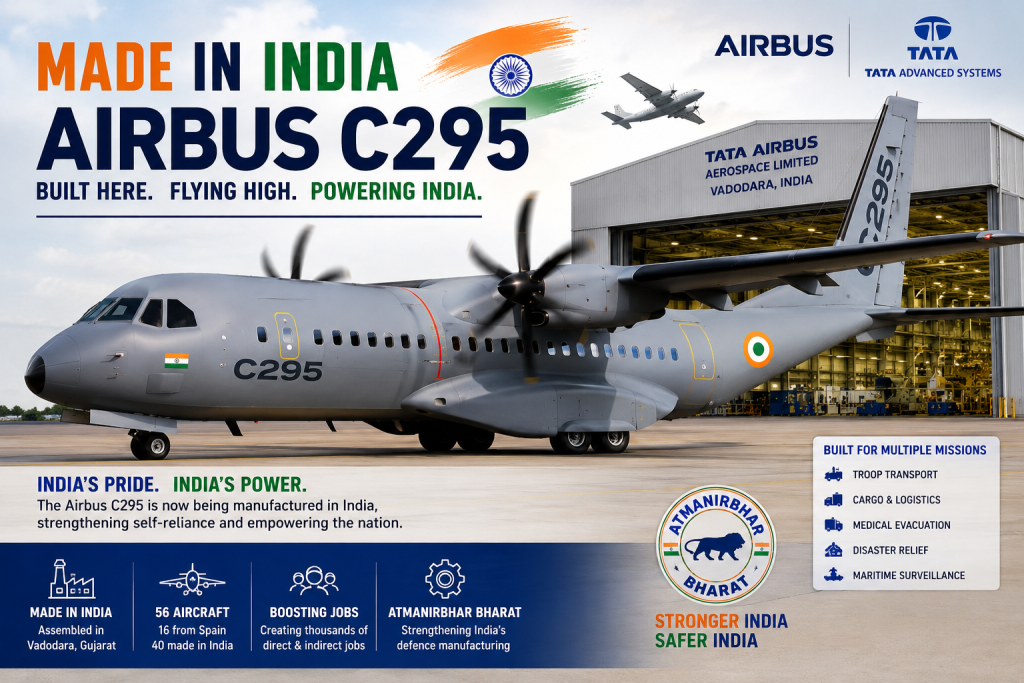
Made-in-India Airbus C295

India’s aviation and defence sectors have achieved a landmark milestone with the successful maiden test flight of the first Made-in-India Airbus C295 military transport aircraft. More than just another aircraft taking to the skies, this event represents years of planning, investment, and collaboration aimed at strengthening India’s manufacturing capabilities and reducing dependence on foreign defence imports
The successful test flight from the Tata-Airbus Final Assembly Line in Vadodara, Gujarat, marks the beginning of a new chapter in India’s aerospace journey. For decades, India has relied heavily on imported military aircraft and defence equipment. The C295 project demonstrates that the country is steadily moving toward becoming a major manufacturing hub for advanced aerospace platforms.
India Brings Advanced Aircraft
For decades, India imported most of its military transport aircraft from foreign manufacturers. Today, the country has started building sophisticated aircraft domestically. The Airbus C295 program demonstrates how Indian industries can produce advanced aerospace systems while meeting global quality standards.
Airbus and Tata Advanced Systems established a modern manufacturing and assembly facility in Vadodara, Gujarat, to support the project. Engineers, technicians, and aviation specialists work together to assemble and test the aircraft before delivery to the Indian Air Force.
The Government of India ordered 56 C295 aircraft for the Indian Air Force. Airbus delivered the first 16 aircraft from Spain, while Tata and Airbus will manufacture the remaining 40 aircraft in India. This initiative has created one of the largest defence manufacturing projects in the country’s private sector.
The Airbus C295 serves as a versatile military transport aircraft capable of performing multiple missions. Air forces around the world use it to transport troops, move cargo, conduct medical evacuation missions, and support disaster-relief operations.
The aircraft can:
Carry troops and military equipment efficiently.
Transport humanitarian aid during emergencies.
Conduct medical evacuation missions.
Operate from short and unprepared runways.
Deliver supplies to remote and difficult locations.
Support tactical operations in challenging environments.
Why the Indian Air Force Needs the C295
The C295 is being inducted to replace the ageing Avro fleet that has served the Indian Air Force for decades. Modern military operations require aircraft that are efficient, versatile, and technologically advanced.
The new aircraft will significantly improve India’s tactical airlift capability. It will allow faster transportation of personnel and equipment to border areas, remote regions, and disaster-affected locations. The aircraft’s ability to operate from shorter runways makes it especially useful in challenging terrains.
In an era where rapid response can make a critical difference during emergencies, the C295.

The Role of Tata and Airbus
One of the most remarkable aspects of the project is the collaboration between Airbus and Tata Advanced Systems.
The manufacturing ecosystem extends far beyond the final assembly line. Components, sub-assemblies, and structural parts are being produced within India, helping create a domestic aerospace supply chain. The project is expected to involve numerous Indian suppliers and generate thousands of direct and indirect employment opportunities over the coming years
Experts believe that the knowledge, skills, and infrastructure developed through this project will benefit future aircraft manufacturing programs as well.
Economic Impact Beyond Defence
The significance of the C295 program is not limited to military aviation.
Large-scale aerospace manufacturing creates demand for engineers, technicians, quality-control specialists, logistics providers, and research professionals. It encourages investment in advanced manufacturing technologies and helps Indian companies integrate into global aerospace supply chains
As more components begin to be produced domestically, India can strengthen its position as an attractive destination for aerospace manufacturing and exports. The experience gained from the C295 program could open doors to additional international collaborations in the future.
Creating Jobs and Developing Skills
The C295 program has already generated employment opportunities across multiple sectors. Engineers, technicians, quality-control specialists, logistics professionals, and manufacturing workers all contribute to the project’s success.
Training programs associated with the project help workers gain valuable expertise in aerospace manufacturing. These skills will remain valuable long after the completion of the current production cycle.
By investing in human capital, India is preparing a workforce capable of supporting future aviation and defence projects.
Supporting the Make in India Vision
The C295 program perfectly aligns with the Government’s Make in India initiative. The project encourages domestic production, attracts investment, and promotes technological advancement.
Instead of relying solely on imported equipment, India now participates directly in the manufacturing process. This approach strengthens national capabilities and reduces dependence on foreign suppliers.
The project also demonstrates how international partnerships can help India acquire advanced technologies while building local expertise.

Political Attention and National Importance
The Airbus C295 project has attracted attention from political leaders, defence experts, and industry stakeholders across the country. Many observers view the program as an important step toward achieving greater self-reliance in defence manufacturing.
Public discussions often focus on job creation, technology transfer, industrial growth, and India’s long-term aerospace ambitions. Regardless of political perspectives, the project highlights India’s determination to expand its manufacturing capabilities and strengthen its defence infrastructure.
A Boost for India’s Global Reputation
The successful flight of the Made-in-India Airbus C295 sends a strong message to the international community. India can now manufacture advanced aerospace platforms while maintaining global standards of quality and safety.
As the country gains experience through projects like the C295, international companies may increasingly view India as a reliable partner for aerospace manufacturing and innovation.
This growing reputation could attract additional investments and create new opportunities for Indian businesses in the global mark
As the country gains experience through projects like the C295, international companies may increasingly view India as a reliable partner for aerospace manufacturing and innovation.
This growing reputation could attract additional investments and create new opportunities for Indian businesses in the global market.
Looking Toward the Future
The maiden flight of the Made-in-India Airbus C295 marks the beginning of a larger transformation. Every aircraft produced in India strengthens the country’s industrial capabilities, creates employment opportunities, and builds technological expertise.
As Tata and Airbus continue production, India will move closer to its goal of becoming a major aerospace manufacturing hub. The C295 program has already proven that Indian industry can successfully handle complex engineering projects and deliver world-class results.
Frequently Asked Questions (FAQs)
1. What is the Airbus C295?
The Airbus C295 is a medium tactical military transport aircraft that carries troops, cargo, medical supplies, and humanitarian aid. Armed forces across the world use it for various military and disaster-relief missions.
2. Who manufactures the C295 aircraft in India?
Airbus and Tata Advanced Systems manufacture the C295 aircraft in India through a strategic partnership. They operate the final assembly line in Vadodara, Gujarat.
3. How many C295 aircraft has India ordered?
The Government of India has ordered 56 Airbus C295 aircraft for the Indian Air Force. Airbus delivered the first 16 aircraft from Spain, while Tata and Airbus are producing the remaining 40 aircraft in India.
4. Why does the Indian Air Force need the C295?
The Indian Air Force uses the C295 to replace its ageing Avro transport fleet. The aircraft offers better technology, improved efficiency, and greater operational flexibility.
5. What missions can the Airbus C295 perform?
The Airbus C295 can transport troops, carry military equipment, conduct medical evacuations, support disaster-relief operations, deliver humanitarian aid, and perform tactical airlift missions.
Conclusion
The Made-in-India Airbus C295 project demonstrates India’s growing strength in aerospace manufacturing and defence technology. Tata Advanced Systems and Airbus have built an advanced military transport aircraft while creating new opportunities for Indian industries, engineers, technicians, and skilled workers.
The project strengthens the Indian Air Force, advances the Make in India initiative, and reduces India’s dependence on imported defence equipment. As Tata and Airbus continue production, India gains valuable expertise, develops advanced manufacturing capabilities, and expands its presence in the global aerospace industry.
The successful C295 program highlights India’s ability to manufacture sophisticated aircraft, build a competitive aerospace ecosystem, and drive innovation in defence production. With every new aircraft, India strengthens its industrial base, creates high-skilled jobs
Click here to read out the article